
You have seen the ads: “Borrow up to 50,000 pesos in 5 minutes, no requirements!” When you are short on cash before payday, it sounds like exactly the help you need. A few taps, and the money lands in your bank account. But before you download that app, it pays to understand what you are really signing up for, because for a lot of Filipinos, these apps have turned a small money problem into a very big nightmare.
💡 Highlights
- An online loan app lets you borrow small amounts of money fast using your phone, with no bank visit and almost no requirements.
- The easy part is real, but so is the danger, especially from apps that are not legal.
- A lot of apps charge way too much interest, so a small loan can double in just a few weeks.
- Illegal apps often copy your phone contacts and shame you to your family and officemates when you are late.
- To be legal, an app must be listed with the SEC and have a permit called a Certificate of Authority. If it does not have one, do not use it.
- Watch out for anyone asking you to pay a “fee” first before releasing a loan. Real lenders never do that.
- The worst part is the cycle: borrowing from one app to pay another, until the debt takes over your life.
What Is an Online Loan App?
An online loan app is exactly what it sounds like: an app on your phone that lets you borrow money without going to a bank. You download it, sign up, snap a photo of your ID and maybe a selfie, and if they approve you, the cash goes straight to your e-wallet or bank account, sometimes within minutes.
They usually lend small amounts for a short time, roughly 2,000 to 20,000 pesos for a few weeks. No long forms, often no payslip needed, and no falling in line. That speed is the whole reason people love them, and also the reason people get into trouble with them.
Why Are Online Loan Apps So Popular in the Philippines?
Because life is expensive and payday always feels too far away. When groceries, tuition, or a hospital bill arrives before your salary arrives, these apps promise a quick fix, with no co-maker, no collateral, and no questions.
They also spread fast because almost everyone has a phone now. Downloading a loan app is as easy as downloading a game. But easy to borrow is not the same as safe to borrow, and that is where a lot of good, hardworking people get hurt. The thing that felt like a rescue slowly becomes the problem itself.
Are Online Loan Apps Safe or Not?
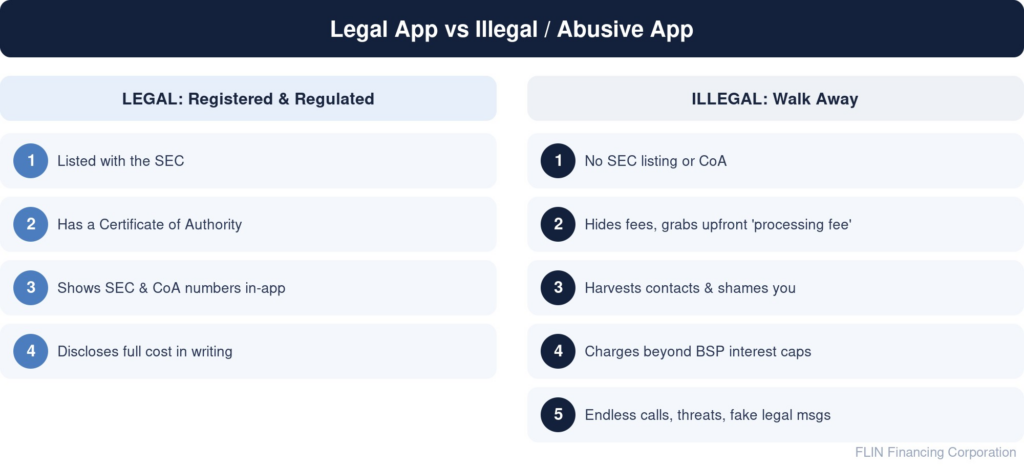
The honest answer: some are legal and fine, and some are outright traps, and from the outside they can look identical. An app can look clean, rack up thousands of downloads and good reviews, and still be completely illegal.
And the danger is not imaginary. As cited from a January 2026 SEC warning, the SEC had to publicly tell people to stay away from 22 illegal loan apps that were still on the Google Play Store without a permit. And those are just the ones caught in a single warning. So no, you cannot assume an app is safe just because it is on the app store. You have to check first, and I will show you how in a minute.
What Makes Some Loan Apps So Dangerous?
Let us talk about the real dangers, the things the ads never mention.
The interest is crazy high
This is the biggest one. As cited from BSP Circular No. 1133, small short-term loans may only charge up to 6 percent interest per month, and no more than 15 percent per month even after you add all the fees. Many illegal apps ignore this and charge so much that your debt can double in just two weeks. So if an app leaves you owing far more than you borrowed after only a couple of weeks, it is almost surely breaking the law.
They hide the real cost
A legitimate lender has to show you, in writing, exactly how much the loan will cost before you agree. As cited from the Truth in Lending Act (Republic Act 3765), that is your right. Bad apps hide the fees, grab a big “processing fee” upfront so you receive less than you borrowed, then charge interest on the full amount anyway. No clear breakdown of the cost? Then do not agree.
They steal your contacts and shame you
This is the cruelest part. Many apps ask to see all your phone contacts the second you install them. Then, if you are even one day late, they message your family, your boss, and your officemates, branding you a scammer to embarrass you into paying.
The calls never stop
People who fall behind get flooded with calls all day, along with threats, curse words, and fake “legal” messages. All of that is illegal, but these apps do not care, because they were never planning to follow the rules in the first place.
How Do You Know If a Loan App Is Legal or Not?
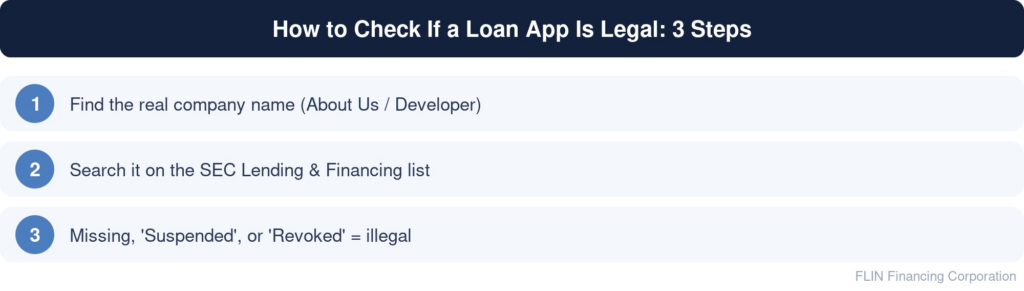
This is the most useful thing you can learn, and it takes only about five minutes. To be legal in the Philippines, a loan app must be run by a company listed with the SEC and holding a permit called a Certificate of Authority. As cited from Philippine legal guides on SEC registration, here is how to check.
1. Find the real company name
The app might be called “QuickCash,” but the company running it usually has a different name. Look under the “About Us” section of the app, or the “Developer” info on the app store.
2. Check the SEC list
Go to the official SEC website and open the list of Lending and Financing Companies. Type in that company name or the app name.
3. Look at what comes up
If the company is not on the list, or it says “Suspended” or “Revoked,” the app is illegal. As cited from SEC Memorandum Circular No. 18, legal apps are required to display their SEC and Certificate of Authority numbers inside the app and in their ads. If those numbers are missing, blurry, or fake, you have your answer.
If an app does not pass this check, do not borrow from it, and you can report it to the SEC.
What Does a Loan App Scam Look Like?
Here is the number one red flag: they ask you to pay a fee first. As cited from SEC guidance, legitimate lending companies and their agents do not ask for advance fees. So if anyone tells you to send money first, for “processing,” “insurance,” “tax,” or to “unlock” your loan, it is a scam. A real lender takes its fee out of the loan; it never asks you to send cash first.
Other common scam signs: an offer that pops up out of nowhere by text or Facebook, a “lender” using a personal Gmail or a cellphone number instead of an official company account, pressure to decide “right now,” and getting approved for a big amount with no requirements at all. If you see these, walk away.
If Loan Apps Have Already Trapped You
If you are reading this already buried under a stack of app loans, borrowing from one just to pay another, please know this: the way out is not one more app. That only feeds the trap. And remember, you cannot be jailed for an honest unpaid loan, so you can face this without fear.
That’s when FLIN comes in. FLIN has a debt consolidation service that can help you to get out of debt. The solution is simple, do a free consultation with us, we can give you a designed-solution for you.
All of your loans will be joined into new installment loans with longer tenure. No more stress in life and calls from debt collectors. If you’re having trouble in debt, don’t be afraid, we are ready to help you, grab our hands and do a free consultation by clicking the button below.
Find more information how to manage your debts via articles below: