
Before you send your ID, pay any fee, or sign a loan agreement, there is one smart move that can save you from a world of trouble: check if the lender is actually legal. It only takes a few minutes, and it is your best protection against predatory lenders and outright scammers.
Key Highlights
- Being “SEC-registered” is not enough. A legal lender also needs a Certificate of Authority to actually lend money.
- The real check takes under 10 minutes and is completely free using the SEC’s official tools.
- Always look up the lender’s real corporate name, not just the app or brand name.
- A legit lender clearly shows its corporate name, SEC registration number, and Certificate of Authority number.
- Never pay an “advance fee” to release a loan. Real lenders do not ask for this. It is a scam sign.
- Not every legal lender is under the SEC. Banks are under the BSP, and cooperatives are under the CDA.
- Operating without a Certificate of Authority is a crime, so an unlicensed lender is breaking the law, not just bending rules.
Why Does This Matter So Much?
Because the difference between a legal lender and an illegal one is the difference between a fair loan and a nightmare. As cited from Philippine legal guidance, verifying a lender protects you from harassment, sky-high interest rates, and privacy violations. Illegal lenders are exactly the ones who shame borrowers, harvest your contacts, and charge rates far above the law.
And here is the key thing most people get wrong. People often say “SEC-registered” to mean “legal,” but for lenders that is not complete. A company can be registered as a corporation yet still have no legal authority to lend money to the public. So you need to check a bit deeper, and these tips show you how.
8 Tips to Verify a Lender Is Licensed
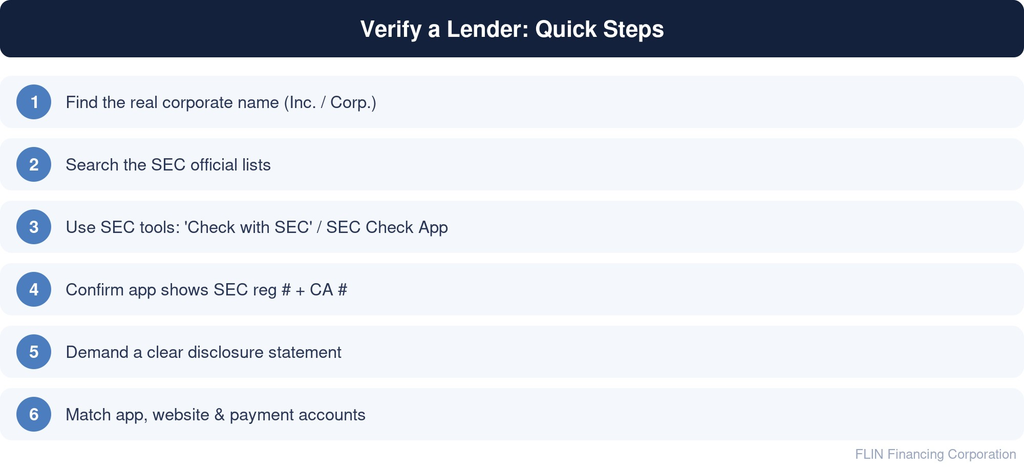
Follow these one by one before you borrow from anyone.
Tip 1: Know the Difference Between “Registered” and “Authorized”
This is the most important tip, so start here. A legal lending company needs two separate things: a Certificate of Incorporation, which just proves the company exists, and a Certificate of Authority, which is the actual permission to operate as a lender.
The Certificate of Authority, or CA, is the one that really matters. No lending company can do business without a valid CA from the SEC. So do not stop at “they are SEC-registered.” Ask specifically about their Certificate of Authority.=
Tip 2: Find the Real Corporate Name First
Do not rely on the catchy app name or brand name. Legitimate companies must use their full registered corporate name, usually ending in “Inc.” or “Corporation,” in their loan agreement, website footer, terms of service, and privacy policy.
So an app might be called “QuickCash PH,” but the real company behind it could be “Juan Dela Cruz Lending Corporation.” You need that real corporate name to run your check. If you cannot even find who really owns the app, that is already a bad sign.
Tip 3: Search the SEC’s Official Lists
Now do the actual lookup. The SEC keeps real-time public lists you can check. Go to the official SEC website, find the “Lending and Financing Companies” or “Public Information” section, and search for the exact corporate name.
There are a few lists worth checking: the List of Lending Companies, the List of Financing Companies, and, for apps, the List of Registered Online Lending Platforms. If the company or app is not on any of these, treat that as a serious red flag.
Tip 4: Use the SEC’s Official Verification Tools
The SEC has made this easier. You can verify a company through the SEC’s official online tools, including the “Check with SEC” portal and the “SEC Check App,” which is the official mobile app of the SEC Philippines for checking company information. If a result is unclear, you can also request confirmation through the SEC’s iMessage service. These are free, official, and quick.
Tip 5: Check That the App or Ad Shows the Right Numbers
Legit lenders are required to be transparent. Lending and financing companies must show their corporate name, SEC registration number, and Certificate of Authority number in their advertisements and inside their online lending platforms.
So open the app or the ad and look, usually in the “About,” “Terms,” or footer section. A real lender displays these numbers clearly. If the numbers are missing, blurry, or fake, walk away.
Tip 6 : Demand a Clear Disclosure Statement
Before you sign anything, you have the right to see the full cost. Lenders must clearly disclose the effective interest rate and the other loan terms. A legitimate lender gives you a written breakdown of the interest, fees, and penalties up front.
If a lender dodges this, hides the real cost, or rushes you to sign without showing the full terms, that is a major warning sign. No clear disclosure, no deal.
Tip 7: Watch the App Permissions and the Payment Accounts
Two quick checks that catch a lot of bad actors. First, be very cautious with apps that demand access to your contacts, photos, or location, or that pressure you to install fast. A legit lender does not need your entire contact list.
Second, as cited from Philippine legal guidance, scammers sometimes copy a real company’s name, number, and logo, so make sure the app, website, payment accounts, and loan documents all belong to the same company. If the loan is from “ABC Lending” but you are told to send payment to a random personal GCash or bank account, stop.
Tip 8: Remember That Not Every Legal Lender Is Under the SEC
One fair point so you do not wrongly panic. Not all credit providers fall under the SEC. Banks and many credit card issuers are supervised by the Bangko Sentral ng Pilipinas, and cooperatives are under the Cooperative Development Authority.
So if a lender is not on the SEC lending list, check whether it belongs to one of these other regulated groups before deciding it is illegal. A bank will not be on the SEC lending company list, and that is normal.
If you are looking for another lender because your existing debts have become difficult to manage, taking on additional borrowing may not always be the best option. Depending on your financial situation and eligibility, debt consolidation may help combine eligible debts into a more structured repayment plan. Click below for free consultation!
Check more tips regarding how to find the best loan brands here :