
“Bad debt” carries two related but distinct meanings, depending on who you ask. For someone managing personal finances, bad debt is a loan that drains your wallet without building anything in return.
For a business tracking its books, bad debt is a customer account that will never see a peso, recorded as a bad debt expense. This guide tackles both angles, so whether you’re sorting out your own loans or need to log uncollectible accounts correctly, you’ll find what you need here.
Key Highlights
- For individuals, bad debt is money borrowed for stuff that loses value or generates zero returns, often at steep interest rates, whereas good debt builds value, income, or security.
- The test for good versus bad debt is straightforward: does the borrowed money earn or save you more than the interest it costs?
- For businesses, bad debt expense is the cost logged when a customer’s account gets written off as uncollectible.
- Businesses record bad debt expense using either the allowance method, where you estimate ahead of time, or the direct write-off method, where you record only once it’s confirmed uncollectible.
- Two formulas help estimate the expense: the percentage of sales method and the percentage of receivables method.
- For Philippine tax purposes, a bad debt is generally deductible only after you’ve actually proven it worthless and written it off, not when you merely estimate it.
- Debt financing and equity financing represent the two main paths to raise money, and finding the right mix depends on cost, control, and risk.
What Is Bad Debt? (The Personal Meaning)
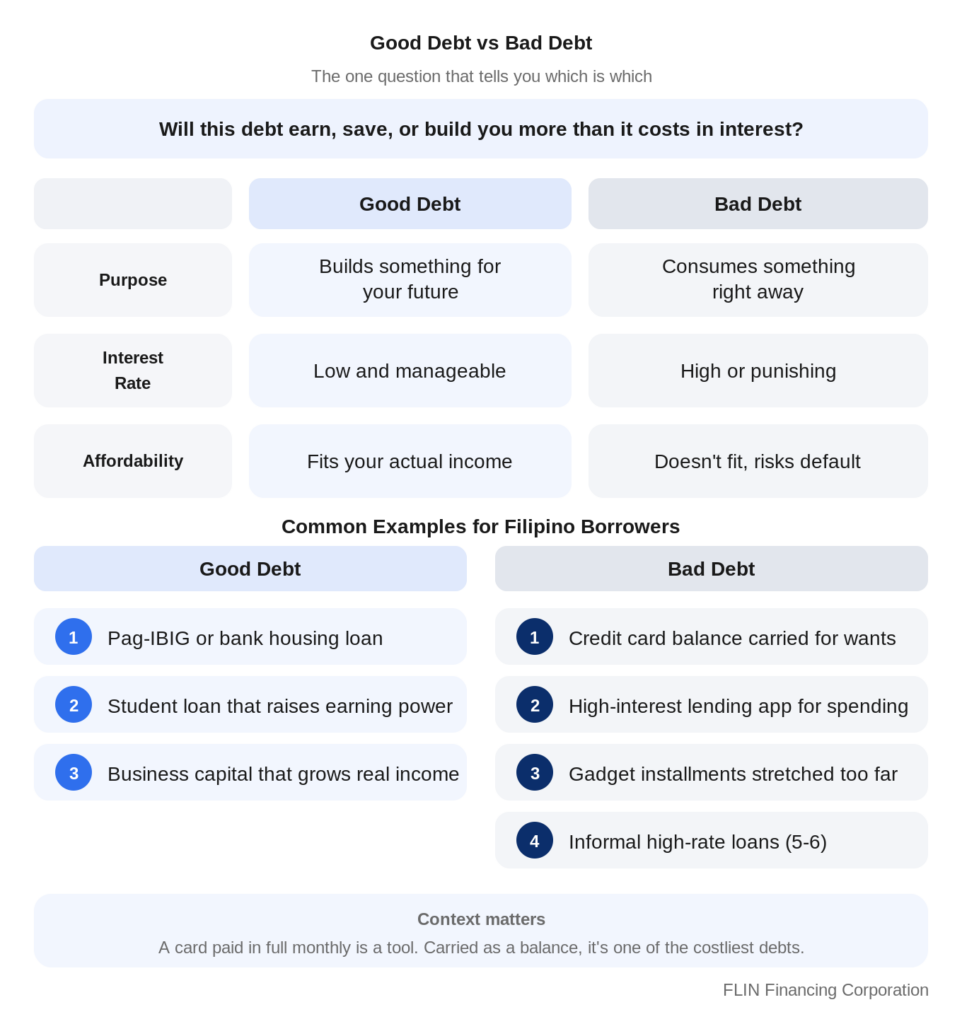
For an individual, bad debt is money you borrow to pay for something that doesn’t build value, doesn’t generate income, and often loses value as time passes, all while charging you high interest for the privilege.
The clearest sign of bad debt: once the loan is gone, you have nothing to show for it except a balance still hanging over your head. Financing a night out, a phone you’ll swap out in two years, or a “want” you couldn’t really afford, on high-interest credit, is textbook bad debt. You pay a premium to own something worth less each month.
The interest rate makes it dangerous. A small balance on a credit card or an online lending app can quietly cost you far more than the original purchase if you only pay the minimum. Bad debt doesn’t just fail to build wealth. It actively drains it.
Good Debt vs Bad Debt
Here is the comparison good debt vs bad debt
How to Avoid Bad Debt
Having a bad debt is an obstale that needs to be passed by doing some following things
Notes the quantity of your debts
You need to take a note of how many debts that you have. To make it easier, you can note the debts by the followin g factors :
- The amount of debts
- Type of debts (online loan/credit card/etc).
- Name of platform
- Due date
By doing this, you are able to set the priority list to ensure the payment is conducted at the right time.
Save some money and don’t do overshopping
Having a lot of loans may bring you to emergency situation. You need to tighten your seatbelt and start to enter the emergency situation.
Don’t worry, this kind of thing shall be pass, as long as you do these two things:
- Start to save some money
By taking a note about how many loans you have, now you have a clear landscape about your financial situation. Thus, you can start to map about how much money you can save per month. This is very important. The small amount of save may lead you to better financial condition. - Don’t do overshopping
We understand, shopping may be a fun activity. However, stop your hobby and don’t do any shoppings, unless grocery shopping.
Find Debt Consolidation Service
If you’re having difficulties in managing the debt, you can start to find the best debt consolidation service. This service can help you in merging all of active loans into manageable loan with lower interest and longer tenure. It comes from FLIN, trusted debt consolidation company in Philippine, that can help you to gain debt-free life.
Find out abouw other articles that can help you to help the debt life: