
At some point, almost everyone needs money they do not have on hand. A medical bill, tuition, a home repair, or a chance you do not want to miss. A personal loan is one of the most common ways Filipinos handle these moments. Used the right way, it is a helpful tool. Used the wrong way, it becomes a weight you carry for years. Read more information regarding it below.
💡 Highlights
- A personal loan is money you borrow and pay back in fixed monthly installments, usually without any collateral.
- You can get one from a bank or through an online lender, and each has its own trade-offs.
- Bank loans usually cost less and lend more, but they are slower and stricter. Online loans are faster but often pricier.
- In the Philippines, bank personal loan interest is often around 1.2 to 2.5 percent per month, while online lenders can go up to the legal cap of 6 percent per month.
- To qualify, you generally need proof of income, valid IDs, and a decent payment record.
- The most important number is not the monthly payment, it is the total cost of the loan once all interest and fees are added.
- Borrowing to pay off other debts with a new loan is risky, and there are often smarter ways to handle that.
What Is a Personal Loan?
A personal loan is a lump sum of money you borrow from a bank or lending company, which you then pay back in fixed monthly amounts over an agreed period, plus interest.
The key thing about most personal loans is that they are “unsecured,” which means you do not have to put up any collateral like a house or car to get one. The lender gives you the money based mainly on your income and your ability to pay it back, not on an asset they can take. That is why it is called personal, it rests on you and your capacity to repay.
People use personal loans for all kinds of things: emergencies, medical bills, school fees, home improvements, a small business, or combining several smaller debts into one. It is flexible, which is part of why it is so popular. But that flexibility also makes it easy to borrow for the wrong reasons, so understanding it matters.
How Does a Personal Loan Work?
The process is fairly simple, and knowing it helps you avoid surprises.
You apply with a bank or lender, showing them who you are and how much you earn. They check if you can afford to repay, looking at your income, your existing debts, and your payment history. If they approve you, they release the money, either to your bank account or as cash, and they tell you your monthly payment, your interest rate, and how long you will be paying.
From there, you pay the same fixed amount every month until the loan is fully paid. Pay on time and everything goes smoothly. As cited from a 2026 Philippine loan guide, miss a payment and you get hit with penalty fees and interest, which also hurts your credit record and makes future loans harder to get. So once you take a personal loan, keeping up with the monthly payment becomes a real responsibility.
What Is the Difference Between a Bank Personal Loan and an Online Personal Loan?
This is one of the most useful things to understand, because the two are quite different.
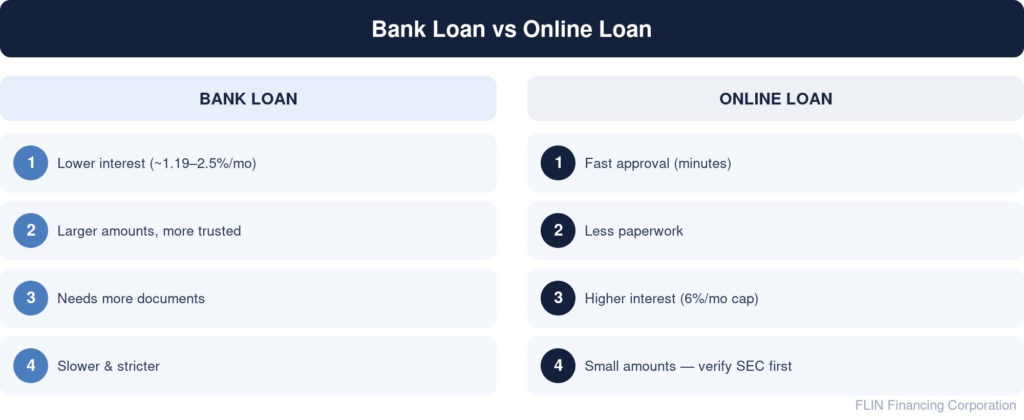
A bank personal loan comes from a traditional bank. As cited from a 2026 Philippine loan comparison, bank loans are generally more trusted, lend larger amounts, and charge lower interest, but they are slower and stricter. You usually need to submit more documents, and approval can take a few days. Banks are best when you need a bigger amount and can wait a little.
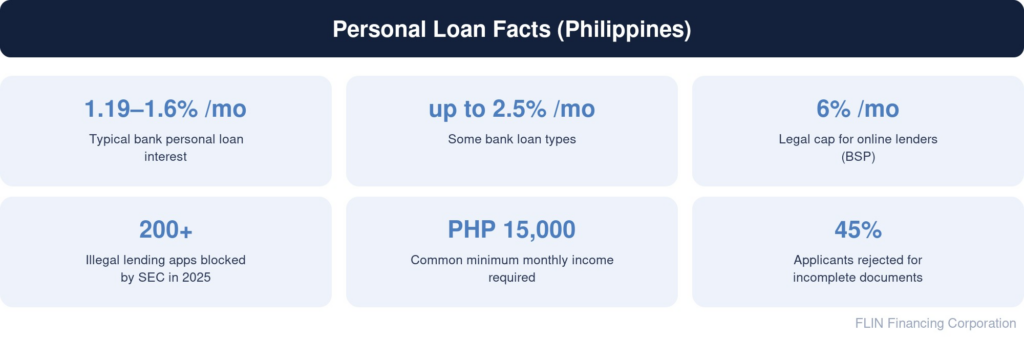
An online personal loan comes from a digital lender or app. These are fast, sometimes approving you in minutes, and require less paperwork. The trade-off is that they usually charge higher interest and lend smaller amounts. And this is important: as cited from a 2026 Philippine loan guide, digital lenders are capped by the BSP at 6 percent interest per month, and the SEC blocked over 200 illegal lending apps in 2025 alone. So before using any online lender, always check that it is registered with the SEC.
In short: banks are cheaper and safer but slower, online lenders are faster but pricier, and with online you must verify they are legal first.
How Much Interest Do Personal Loans Charge in the Philippines?
This is where the real cost lives, so pay attention. Bank personal loan interest often ranges from about 1.19 to 1.6 percent per month, though some banks charge closer to 1.75 to 2.5 percent depending on the loan type. Online lenders can go higher, up to the legal cap of 6 percent per month.
Two things matter more than the advertised rate. First, always ask for the effective interest rate, sometimes called EIR, because it includes the fees and gives you the true cost, not just the headline number. Second, look at the total amount you will repay over the whole loan, not just the monthly payment. A small monthly payment stretched over a long time can quietly cost you a lot more in total interest. As cited from a Philippine loan guide, comparing the total cost, not just the monthly payment, is the smartest habit before you borrow.
What Are the Pros and Cons of a Personal Loan?
On the good side, it gives you access to a lump sum when you need it, it does not require collateral, and it turns a big expense into predictable monthly payments you can plan around. Paid on time, it can even help build a good credit record for the future.
On the tough side, it is still debt with interest, so you pay back more than you borrowed. The fixed monthly payment does not care if you have a hard month. And if the rate is high, especially from an online lender, the cost can pile up fast. Miss payments, and penalties and credit damage follow.
When Is a Personal Loan a Bad Idea?
Here is the honest truth most ads will never tell you: a personal loan is easy to get, and that is exactly what makes it dangerous. Because approval can be quick and the monthly payment looks small, it is tempting to keep borrowing, one loan for the phone, another for the trip, another to cover the last one.
But every loan you add is another fixed payment locked into your salary, whether the month is good or bad. Stack too many, and one day you look at your payslip and realize most of it is already gone before you have even bought food or paid rent. That is how a simple, helpful tool quietly turns into a trap.
So the rule is simple: use personal loans sparingly, and only when they truly make sense. One loan you can comfortably repay is a tool. Three or four loans piled on top of each other is a problem waiting to happen.
And, if it’s already overcontrolled, it’s time to stay calm and consult with FLIN. We offer trusted service to manage the loan. If you already have problems manaaging multiple loans , FLIN can help you to consolidate your all loans and have just one loan with longer tenure , lower interest rates and lower installments upto 60 %. Do a free consultation by clicking button below.
Click articles below to find out how to manage your loan properly: