
Your phone buzzes nonstop. Missed calls from numbers you don’t recognize. Text messages that get harsher each time. Then one message lands with your officemate, or worse, in your family group chat, laying your debt out for everyone to see. If a debt collector is doing this to you, know this right now: a lot of what they’re doing is illegal, and you have real power to stop it.
💡 Highlights
- A debt collector can remind you and ask you to pay, but they can’t threaten, shame, or harass you.
- Under Philippine rules, collectors can’t call you before 6 in the morning or after 10 at night.
- They’re not allowed to contact your family, friends, boss, or phone contacts to embarrass you, only a co-maker or guarantor.
- Harassment, public shaming, and harvesting your contact list are illegal and you can report them.
- Your strongest moves are to document everything, send a written cease-and-desist, and report them to the right agency.
- Collectors and lenders who break these rules face heavy fines and can even lose their license.
- Owing money isn’t a crime, and no collector can have you arrested over an ordinary unpaid loan.
Who Is a Debt Collector, and Can They Really Do Anything to Me?
A debt collector is just a person or company whose job is to get you to pay back a loan. They might work inside the bank or lending company, or be a separate agency hired to chase the debt, or be the collections team of an online lending app. That last group causes the most trouble.
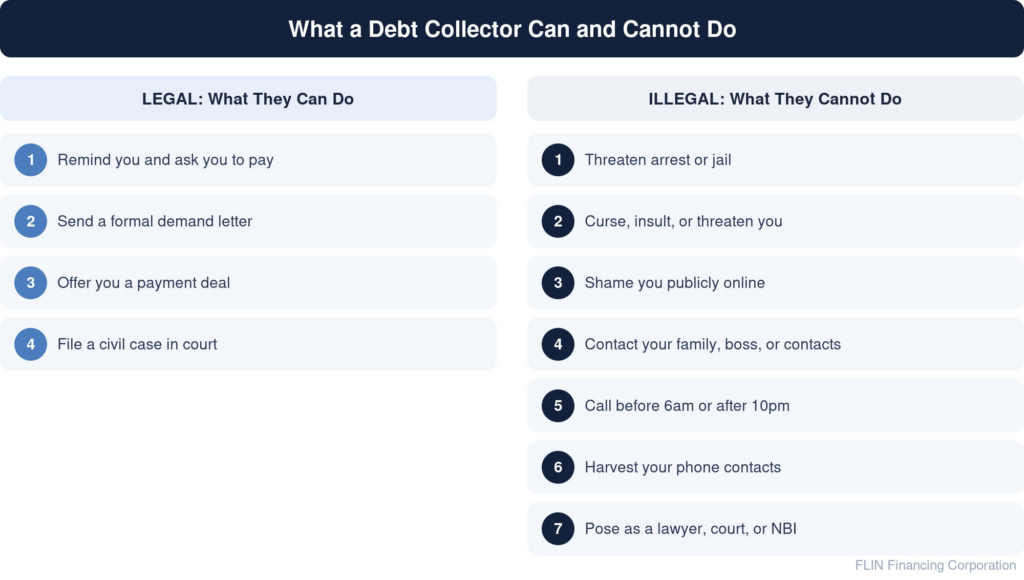
Here’s what a collector can honestly do: call or message you to remind you, send you a formal demand letter, and offer you a payment deal. If you still don’t pay, the most they can do is file a civil case in court to try to recover the money. That’s it.
What they can’t do is a much longer list, and that’s where most of them break the law every single day.
Is It Legal for a Debt Collector to Harass You in the Philippines?
No. It’s not legal, and it’s not a gray area.
As cited from SEC Memorandum Circular No. 18, series of 2019, lending and financing companies are banned from using unfair debt collection practices. On top of that, as cited from Republic Act No. 11765, the Financial Consumer Protection Act, abusive collection can be punished with serious penalties. As cited from a 2025 report by the Philippine Information Agency quoting the SEC, collectors calling you between 10:01 in the evening and 5:59 in the morning is already considered an unfair practice on its own.
So when a collector harasses you, they’re not just being rude. They’re breaking rules that carry real consequences for their company. Keep that in mind, because it flips the power back to you.
What Counts as Debt Collector Harassment?
A lot of people put up with harassment because they’re not sure it “counts.” Let’s make it clear. Harassment includes things like:
- Calling and texting you over and over, all day, to wear you down.
- Contacting you very early in the morning or late at night.
- Using threats, curse words, or insults.
- Threatening you with arrest or jail, which is a bluff for an ordinary debt.
- Posting about your debt on social media or messaging your contacts to shame you.
- Pretending to be a lawyer, court officer, or NBI agent to scare you.
If any of these are happening to you, that’s not a tough collection. That’s illegal harassment, plain and simple.
Can a Debt Collector Call Your Family, Boss, or Contacts?
This is the one that hurts people the most, so pay close attention. The answer is no.
As cited from the SEC through the Philippine Information Agency, a collector is only allowed to contact your guarantor or co-maker, meaning someone who actually signed onto your loan with you. They’re not allowed to call your friends, your relatives, your officemates, or your boss to pressure or embarrass you.
Many online lending apps ask for permission to see all your phone contacts the moment you install them, then use that list as a weapon. As cited from the National Privacy Commission, online lenders are barred from harvesting your phone and social-media contact lists, and apps have been ordered to erase the data they grabbed illegally and to pay fines. So if an app is texting your contacts, they’re breaking privacy law, and you can act on it.
What Should You Do When a Collector Calls?
Don’t panic, and don’t just hang up in fear. Handle it calmly, like this.
First, stay polite but firm. You don’t have to argue or explain your life story. Second, ask for the basics in writing: the name of the company, how much they claim you owe, and proof they’re authorized to collect. Legitimate collectors can provide this. Scammers can’t.
One warning here. As cited from the SEC, legitimate lending and financing companies and their agents don’t ask for advance fees. So if a “collector” asks you to send money first to settle or to stop a case, that’s a scam. Don’t send anything.
And most importantly, from this moment on, start keeping records of everything.
How Do You Make the Harassment Stop?
Here’s the part you came for. There’s a clear, proven way to shut down an abusive collector.
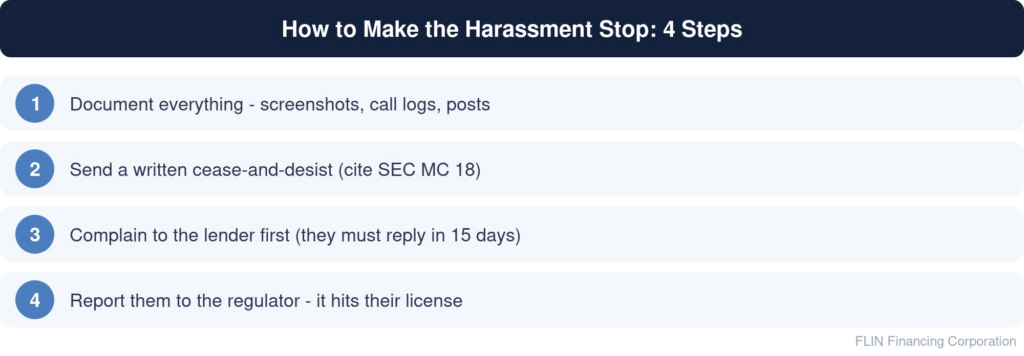
Step 1: Document everything. Screenshot every text and chat. Save call logs with dates and times. Keep the shaming posts. This evidence is your ammunition, and collectors who know you’re recording tend to behave.
Step 2: Send a written cease-and-desist. Put it in writing, politely but clearly, that they must stop contacting you improperly and route everything through you. As cited from legal commentary by lawyer-philippines.com, sending a cease-and-desist that specifically points to SEC MC 18 often makes collectors back off, because now they know that you know the rules.
Step 3: Complaint to the lender first. As cited from Republic Act No. 11765, lenders are required to address your complaint within 15 days before you take it to the regulators. So file a formal complaint with the company’s customer care or compliance office, and demand a written response.
Step 4: Report them to the regulator. If they keep it up, escalate. This is the step that actually scares them, because it hits their license.
Where Do You Report Debt Collector Harassment?
Match the problem to the right office. As cited from Philippine legal guidance on collection practices, these are your channels:
- For abusive collection by a lending or financing company, report to the Securities and Exchange Commission (SEC).
- For your contacts being harvested or your data misused, report to the National Privacy Commission (NPC).
- For harassment by a bank or bank-linked collector, raise it with the bank, then the Bangko Sentral ng Pilipinas (BSP).
- For threats, fake posts, or cyber-shaming, go to the NBI Cybercrime Division or the PNP Anti-Cybercrime Group.
These aren’t empty complaints. As cited from Philippine legal guidance, the SEC can impose fines of up to 1 million pesos per violation and even revoke a lender’s license, and under RA 11765, violators can face fines up to 2 million pesos or imprisonment of up to 5 years. Collectors know this, which is why a borrower who mentions reporting is suddenly treated very differently.
Can You Get Money From a Collector Who Harassed You?
This surprises people, but yes, it’s possible. As cited from legal commentary by lawyer-philippines.com, Philippine trial courts have started awarding borrowers moral damages, in the range of 50,000 to 200,000 pesos, for debt-collection harassment, using the Civil Code rule against acts that violate a person’s dignity. It’s not guaranteed, and it usually needs a lawyer and good evidence, but it shows how seriously the harm is now being taken. This is one more reason to document everything.
If the Debt Is Real, Do I Still Have to Deal With It?
Yes, and this is the honest part. Stopping the harassment doesn’t erase the debt. They’re two separate things. The collector may be breaking the law with how they chase you, but if you genuinely borrowed the money, you still owe it.
So handle both. Shut down the illegal harassment using the steps above, and at the same time, make a real plan for the debt itself. And remember, as covered by the Constitution, you can’t be jailed for an honest unpaid loan, so you’re dealing with this from a position of safety, not fear.
Facing this problem is really concerning and, you don’t know how to solve the problems. This case is not only faced by you, thousands of people are facing the same. Running from debt collectors is not the solution, debt consolidation is.
Debt consolidation merges all the loans into one manageable installment. Instead of paying one by one, this solution can ease your burden 2x times. This is what FLIN realizes and try to help you.
With this solution, you are able to gain a new life, debt-free without any anxious feelings for being chased by collectors. Consult with us, without judgement by clicking the button below!
Find out more about how to face debt collectors below: