
A collector calls. The voice is angry. They say if you do not pay by Friday, they will file a case, send the police, and have you arrested. Your heart drops. You start to panic.
Before you do anything, you need to know one thing: most of what that collector just told you is not true. This article digs into what the law in the Philippines actually says about unpaid debt, what can really happen to you, and what is just a scare tactic meant to frighten you into paying. It is written in plain language for ordinary working people, so no legal jargon, just the facts.
💡 Highlights
- You cannot be sent to jail just for failing to pay a normal debt. The Constitution itself says so.
- An ordinary unpaid loan is a civil matter, which means at most you can be sued for the money, not arrested.
- The most common case filed against a non-paying borrower is a small claims case for the amount owed.
- Jail only becomes possible if there is a separate crime, like a bounced check (BP 22) or fraud (estafa).
- Simply being unable to pay is not fraud. Fraud means you lied or tricked someone from the very start.
- A collector threatening you with immediate arrest for an unpaid loan is bluffing.
- If you truly cannot pay, ignoring court papers is the real danger, not the debt itself.
Can You Go to Jail for Not Paying Debt?
Let us answer the big question first, plainly. No. You cannot be jailed simply because you could not pay a debt.
As cited from Article III, Section 20 of the 1987 Philippine Constitution, “no person shall be imprisoned for debt.” That is the highest law in the country, and it protects anyone who honestly borrowed money but later could not pay, whether it is a bank loan, a credit card, an online loan, an installment, rent, or utang to a friend.
So if you lost your job, got sick, or your business failed and now you cannot pay, you are not a criminal. You owe money, yes, and that has to be dealt with. But owing money is not a crime, and no judge can throw you in jail for it alone.
Then Why Do Collectors Keep Threatening Me With Jail?
Because fear makes people pay. That is the whole game.
Many collectors, especially from online lending apps, know that most Filipinos do not know their rights. So they use the scariest words they can find. “Arrest.” “Warrant.” “NBI.” “Barangay hearing.” They know that a frightened person pays faster than a calm one.
But here is the truth. A collector cannot have you arrested. Collectors are not police. They cannot issue a warrant. They cannot decide you are guilty of anything. The most they can actually do is file a civil case in court to try to recover the money, and that is a slow, paper-based process with no jail at the end of it. When someone threatens you with immediate arrest over a plain unpaid loan, they are bluffing, and now you know it.
What Actually Happens If You Cannot Pay?
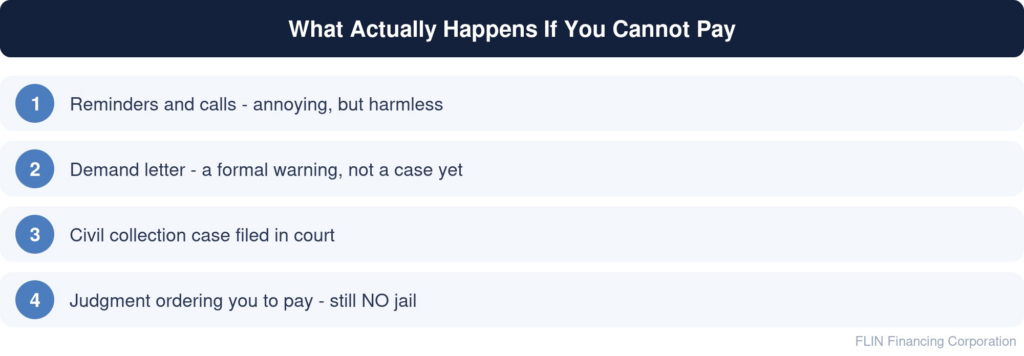
Here is the real process, step by step, for a normal unpaid debt.
First, you get reminders and calls. Annoying, but harmless. Next, the lender usually sends a demand letter, which is a formal paper asking you to pay by a certain date. This is not a court case yet. It is just a warning shot.
If you still do not pay, the lender can file a civil collection case in court. This is a lawsuit for the money. If the court agrees you owe it, it issues a judgment ordering you to pay. Even then, nobody goes to jail. The court simply tries to collect what you owe, which we will explain in a moment.
What Is a Small Claims Case, and Should I Be Scared of It?
The most common case a lender files for unpaid debt is a small claims case, so it helps to understand it.
A small claims case is a simplified court process for money disputes. As cited from the Supreme Court’s rules on small claims, it covers amounts up to 1,000,000 pesos, and no lawyers are allowed to argue the case for either side. You represent yourself using simple official forms. It is designed to be fast and cheap, exactly so ordinary people can use it without paying for a lawyer.
Should you be scared? Not really. A small claims case can only end in one thing: an order to pay the money, sometimes with a payment schedule. It cannot send you to jail. If you receive small claims papers, the worst mistake is to ignore them. Show up. Explain your situation. Judges in these cases often help both sides agree on a realistic payment plan.
When Can Unpaid Debt Actually Send You to Jail?
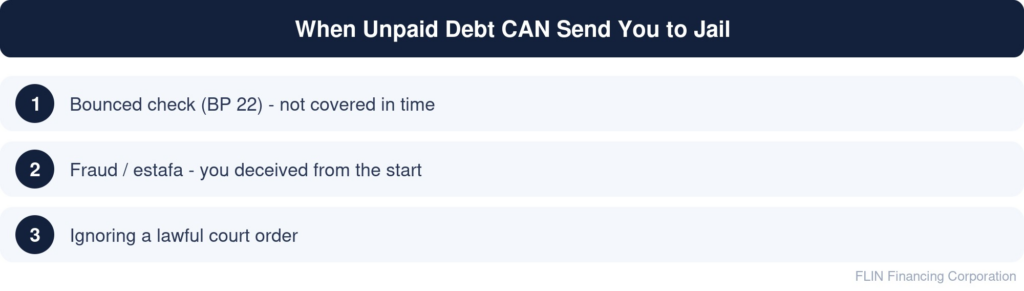
As cited from legal analysis by Respicio and Co on Philippine law, the main pitfalls are these:
- You issued a check that bounced. This is the big one. Under a law called Batas Pambansa 22, or the Bouncing Checks Law, issuing a check that bounces because of insufficient funds can be a crime, even if it was for an old debt. Important: the law gives you five banking days after you are formally notified to make the check good. Cover it in time and you avoid the offense.
- You committed fraud, called estafa. This is when you tricked someone to get the money. More on this next, because it is widely misunderstood.
- You ignored a lawful court order. If a court orders something and you willfully defy it, that defiance itself can carry a penalty. Again, that is about disobeying the court, not about the debt.
If none of these apply to you, and for most honest borrowers none do, then you cannot be jailed.
What Is the Difference Between a Civil Case and Estafa?
This is the confusion that scares people the most, so let us make it dead simple.
A civil case is about money. It says: “You owe me. Pay me back.” The ending is an order to pay. No jail.
Estafa is about lying. As cited from Article 315 of the Revised Penal Code, estafa is a form of swindling where someone uses deceit, false pretenses, or abuse of confidence to trick another person out of money or property. The ending can include jail.
Here is the key that most collectors hope you never learn. As cited from Supreme Court rulings, simply failing to pay a legitimate debt is not estafa. For it to be estafa, the fraud must have existed at the very start, when you got the money. Think fake identity, forged documents, or lying about something important to trick the lender into handing over cash.
So if you borrowed honestly, meant to pay, and later just could not because life happened, that is a civil matter. That is not estafa, no matter how loudly a collector shouts the word.
What Case Can Be Filed for Not Paying Debt?
Whether you are the one who owes money or the one who is owed, here is what can actually be filed.
For an ordinary unpaid debt, the case is a civil collection case, and for amounts up to 1,000,000 pesos, that usually means a small claims case. This is the normal, everyday route. For smaller disputes between two individuals in the same city or town, the law often requires them to try barangay mediation first, before any court case.
A criminal case can only be filed if there is a real crime attached, like a bounced check under BP 22 or actual fraud under estafa. Without those elements, there is no criminal case to file, only a civil one for the money.
So if a friend borrowed from you and will not pay, the realistic move is a demand letter, then barangay mediation, then a small claims case. And if someone is threatening to file a criminal case against you over a plain unpaid loan, remember they need an actual crime to do it, which an ordinary debt does not have.
Can They Take My Salary or My Things?
This worries a lot of workers, so let us be clear. Only after a lender wins a civil case and gets a court judgment can they ask the court to enforce it. The court, through a sheriff, may then try to collect from certain property or assets you own.
But there are limits. The law protects basic necessities, and the sheriff cannot seize property that is exempt or that does not exist. And to be clear, this only happens after a full court process, with a judgment, not because a collector called and demanded it. No collector can freeze your bank account or grab your salary with a phone call.
Can a Very Old Debt Still Be Used Against Me?
Sometimes, not. Debts have a time limit for suing, called prescription.
As cited from the Civil Code of the Philippines, a debt based on a written contract can generally be sued on for up to 10 years, and one based on a verbal agreement for about 6 years. After that window closes, the lender may lose the right to enforce it in court. This is a detail worth checking, because some collectors chase very old debts that may no longer be enforceable. If a debt is extremely old, it is worth asking a lawyer whether it has already prescribed.
What Should You Do If You Cannot Pay or Get Sued?
Panic is the real enemy here, so here is a calm, practical plan.
Do not hide, and do not ignore court papers. This is the single most important rule. If you receive a real court notice and skip it, the court can decide against you automatically, just because you did not show up. Always respond and always attend.
Do not issue post-dated checks you are not sure you can cover, since that is what turns a simple debt into a possible BP 22 case. Ask for everything in writing, including proof of how much you owe and where to pay it, and never pay into a collector’s personal account without clear authorization. Keep records of every payment.
And if the debt is simply too big for your salary to handle, do not wait for it to explode. The earlier you act, the more options you have to fix it calmly.
One honest note: this article is general information to help you understand your rights, not formal legal advice. For your specific situation, especially if a real case has been filed, talk to a lawyer. Free legal help is available from the Public Attorney’s Office for those who qualify.
If you’re getting pressured by an endless debt cycle, the only thing you need is debt consolidation. FLIN understands this problem as something critical that is faced by many people, including Filipinos.
FLIN can merge all of your loans into one easy-to-pay installment with lower interest rates and flexible tenure up to 36 months. This is something that people really need, a manageable installment plan, so they can still arrange their finances very steady. Later, the fund will be transferred to lenders’ accounts, so the money is used correctly. If you’re facing this, you’re not alone, click the button below for free consultation.
Read the articles below to find out how to solve your debt problems: