
Sooner or later, almost everyone hits the same wall. You need to pay for something right now, a medical bill, tuition, a motorcycle to get to work, a home, and the cash just isn’t there. At that point you have two choices. You can wait and save until you have the full amount, or you can borrow it and pay it back over time. That second choice is debt financing.
This guide explains what debt financing actually means for you as an individual, the forms it takes in the Philippines, the honest advantages and disadvantages, and how to tell whether borrowing is the right move or the start of a problem.
💡 Highlights
- Debt financing means covering a need now by borrowing money that you repay with interest over an agreed term.
- It lets you access something today instead of waiting years to save the full amount.
- Common examples include personal loans, salary loans, credit cards, auto loans, home loans, and installment or paylater plans.
- The main advantages are immediate access, spreading a large cost into manageable payments, and building a credit history.
- The main disadvantages are the total cost of interest, fixed obligations that ignore your circumstances, and the risk of losing collateral.
- Debt financing works when the borrowed money buys something worth more than the interest it costs you.
- The line between helpful borrowing and dangerous debt is whether the repayment fits comfortably inside your real income.
What Is Debt Financing?
Debt financing is covering a purchase or a need by borrowing money from a lender, with a legal obligation to repay the amount you borrowed plus interest over a set period.
The definition is simple, but the important part is the trade behind it. When you finance something with debt, you choose to have it now and pay for it later, and the price of that convenience is interest. You are essentially buying time. The lender gives you access to money you do not yet have, and in return you pay back more than you took, spread across months or years.
That trade is not automatically good or bad. It depends entirely on what you are financing and whether the repayment fits your life. Borrowing to get to a job that pays your bills is very different from borrowing to fund a lifestyle you cannot yet afford, even though both are debt financing.
How Debt Financing Works
The mechanics are straightforward. You approach a lender, whether a bank, a financing company, a cooperative, or a lending app, and request the amount you need. The lender assesses the risk by looking at your income, your employment, your existing debts, your credit history, and, for larger loans, whatever collateral you can offer.
If approved, both sides agree on the terms: the amount, the interest rate, the monthly payment, the length of the loan, and any security attached. You receive the funds, or the item is released to you, and you begin repaying on schedule. The lender’s return is fixed at the interest agreed. Whether your month goes well or badly, the payment stays the same, and if the loan is secured, missing payments can cost you the asset.
That is the part borrowers underestimate. The lender’s promise to you is flexible on the day you apply and rigid on every day after. The obligation does not adjust to your circumstances once it is signed.
This process also becomes one of debt consolidation processes that merge all of your debts into a single loan with manageable interest and longer tenure. For more information, you can visit here.
Debt Financing Examples
Here are the forms debt financing actually takes for individuals in the Philippines.
- Personal loans. A lump sum from a bank or lending company, repaid in fixed monthly installments, often unsecured. Used for emergencies, consolidation, tuition, or major personal expenses.
- Salary loans. Borrowing against your future pay, common through employers, government agencies like SSS or GSIS, or banks, with repayments deducted from your salary.
- Credit cards. A revolving line you draw on for purchases and repay monthly. Convenient, but among the most expensive forms of financing if you carry a balance rather than paying in full.
- Auto and motorcycle loans. Financing a vehicle where the vehicle itself is the collateral, repaid over several years. Miss enough payments and the lender can repossess it.
- Home loans. A long-term, secured loan to buy or build property, usually the largest and cheapest-rate debt most people ever take, backed by the home itself.
- Installment and paylater plans. Financing a gadget, appliance, or purchase in fixed monthly amounts, either through a store plan or a paylater app. Easy to enter, easy to overuse.
- Cooperative and pawnshop loans. Community-based lending and asset-backed short-term loans that many Filipinos rely on for quick access outside the banking system.
Too many debts, too many due dates? Debt consolidation rolls them into one. FLIN helps you combine pinjol, credit cards, paylater, and personal loan into a single monthly payment, often with a lower rate or longer tenor when secured with an asset.
The Good and Bad of Debt Financing
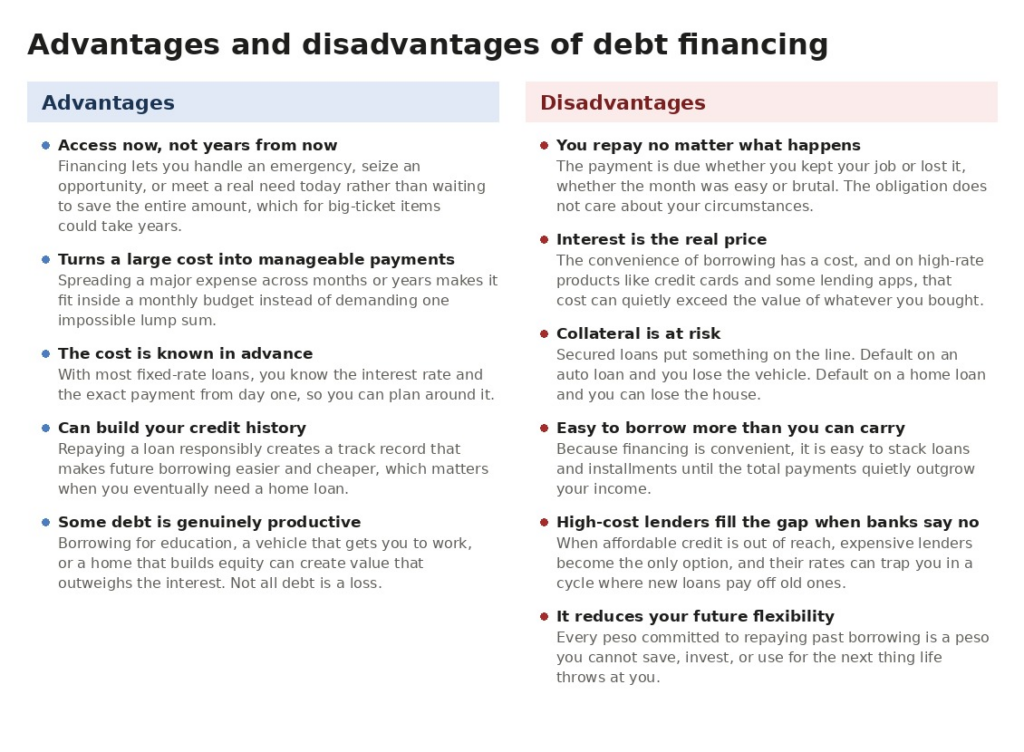
When you’re paying off one loan by taking another, the numbers only grow. Debt consolidation breaks that cycle: your existing debts are merged into one fixed payment you can actually plan around. FLIN maps your full financial picture first, then facilitates consolidation with the safest solutions.
Consult with FLIN, we are trying to give you the best solution based on your condition. No judgment and we can assure your data is safe which is arranged by the highest safety standards. All are free, and you can feel safe here.
Click articles below to find out more about how to solve debt: