

Most people buried in debt don’t quit because the math is too hard. They quit because nothing seems to happen. You pay and pay, and every balance still looks roughly the same. The debt snowball method exists to solve exactly that problem. It’s built less around interest rates and more around momentum, and for a lot of Filipino borrowers, momentum is the thing that actually gets the debt paid.
This guide explains what the snowball method is, how to run it step by step, where it beats the alternative, where it costs you money, and how to decide if it fits your situation.
Key Highlights
- The debt snowball method means paying off your smallest balance first, then rolling that payment into the next smallest, and so on.
- You still pay the minimum on every other debt. Only the extra money goes to the target debt.
- Each cleared debt frees up its payment, so the amount you throw at the next one keeps growing, like a snowball rolling downhill.
- It is a behavioral strategy, not a mathematical one. It’s designed to keep you motivated long enough to finish.
- The trade-off is cost. Ignoring interest rates usually means you pay more in total than with the avalanche method.
- It works best when you have several small balances, when you have quit before, or when you need a visible win to stay in the game.
- It works poorly when one debt carries a punishing rate, since that balance grows while you focus elsewhere.
What Is the Debt Snowball Method?
The debt snowball method is a repayment strategy where you order your debts from the smallest balance to the largest, ignoring interest rates entirely, and attack the smallest one first with every extra peso you have. Every other debt gets only its minimum payment.
When the smallest debt hits zero, you take the full amount you were paying on it and add it to the minimum of the next smallest debt. Clear that one, and both payments roll into the third. The payment you’re making on your target debt gets bigger with every debt you kill, which is where the snowball name comes from. It starts small, gathers mass, and by the end it’s moving fast enough to flatten balances that once felt impossible.
The core insight is psychological. Debt repayment is a long game, and the biggest risk isn’t a suboptimal interest rate. It’s you giving up in month four. The snowball buys you an early win, and early wins keep people in the game.
How the Debt Snowball Method Works, Step by Step
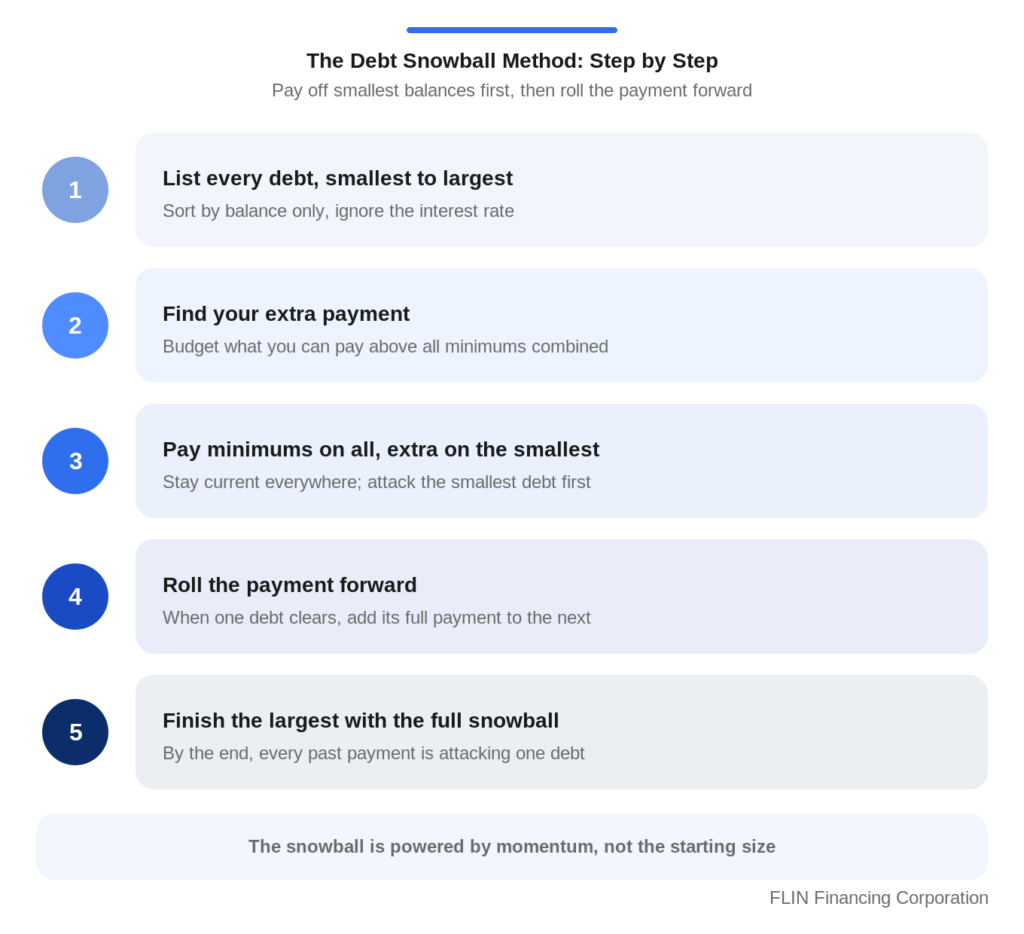
Step 1: List every debt by balance, smallest to largest
Write down every debt you owe: credit cards, salary loans, lending app balances, personal loans from family, paylater accounts, everything. Note the outstanding balance and the minimum payment for each. Then sort the list by balance only. Don’t look at the interest rate. That’s the whole point of this method.
Step 2: Find your extra payment
Look at your monthly budget and figure out how much you can put toward debt above the total of all your minimums. This might be two thousand pesos, it might be ten thousand. Whatever it is, that’s your attack money. Even a small extra amount works, because the snowball is powered by the rollover, not by the starting size.
Step 3: Pay minimums on everything, and everything on the smallest
Keep every account current with its minimum payment so you don’t trigger penalties or fresh defaults. Then send every peso of your extra payment to the smallest balance on your list. Nothing else changes.
Step 4: Roll the payment forward
Once the smallest debt is cleared, don’t absorb that money back into your lifestyle. This is the step everyone gets wrong. Take the entire payment you were making on that debt, minimum plus extra, and add it to the next debt’s minimum. Repeat down the list.
Step 5: Finish the largest debt with the full snowball
By the time you reach your biggest balance, you’re attacking it with the combined payments of every debt you’ve already killed. This is why the last debt often falls faster than people expect, even though it looked the scariest on day one.
A Simple Example
Say you owe the following:
- Lending app balance: 8,000 pesos, minimum 800
- Credit card A: 25,000 pesos, minimum 1,250
- Credit card B: 60,000 pesos, minimum 3,000
- Personal loan: 120,000 pesos, minimum 5,000
Your minimums total 10,050 pesos, and you can afford 13,000 pesos a month. That gives you 2,950 pesos of attack money.
You send 3,750 pesos to the lending app, since that’s its 800 minimum plus your 2,950 extra, and clear it in about three months. That first win comes fast, and it matters more than it sounds.
Now that 3,750 rolls into credit card A. You’re paying 5,000 a month on it instead of the 1,250 minimum. When it clears, all 5,000 rolls into credit card B, making that payment 8,000. Clear that, and the personal loan gets hit with 13,000 a month instead of 5,000.
Notice what happened. Your total monthly outlay never changed. It was 13,000 pesos the whole way through. But the force landing on each individual debt kept compounding.
Snowball vs Avalanche: Which One Should You Use?
The avalanche method is the snowball’s main rival. It works identically, except you order your debts by interest rate instead of balance, attacking the most expensive debt first.
The honest comparison looks like this:
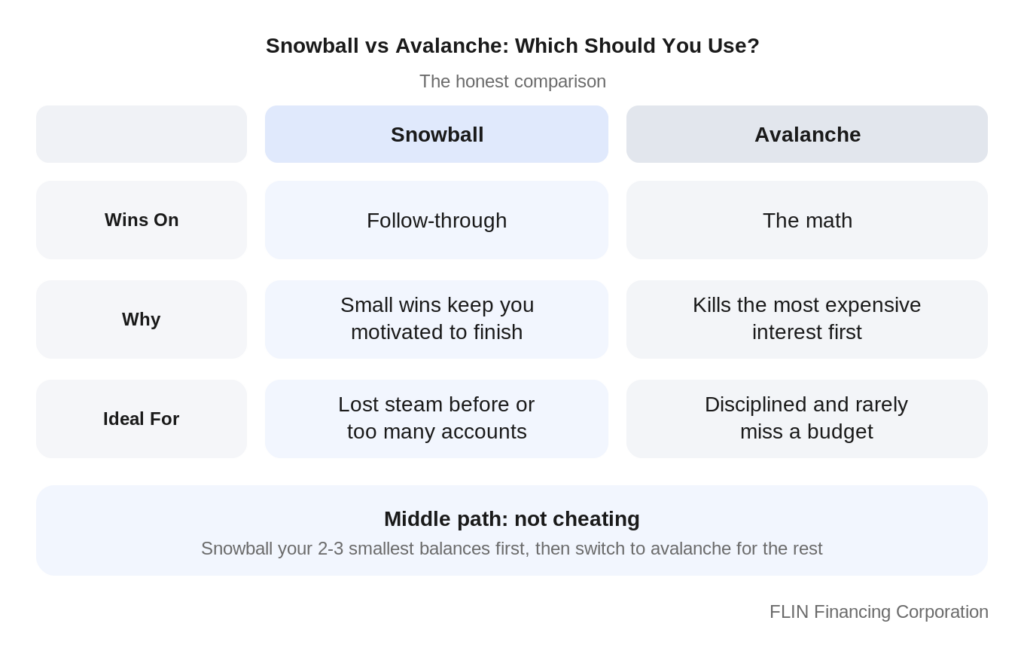
- The avalanche wins on math. By killing high-rate debt first, you stop the most expensive interest from compounding. Over a long payoff, this saves you real money, sometimes tens of thousands of pesos.
- The snowball wins on follow-through. Researchers studying debt repayment have consistently found that people who clear small balances first are more likely to stay with the plan and actually finish. A slightly more expensive plan you complete beats a cheaper plan you abandon in month five.
- The practical rule: if you’re disciplined, numbers-driven, and have never struggled to stick with a budget, run the avalanche. If you’ve tried to pay down debt before and lost steam, or if the sheer number of accounts is what’s crushing you, run the snowball. The best method is the one you’ll still be running a year from now.
- There’s also a middle path. Some people snowball their two or three smallest balances to build momentum, then switch to avalanche for the rest. That’s not cheating. That’s using both tools for what each is good at.
When the Debt Snowball Works Well
The snowball is a strong fit when several of these are true:
- You have multiple small balances scattered across cards, apps, and informal loans.
- Your interest rates are broadly similar, which makes the avalanche’s advantage small anyway.
- You’ve started a debt payoff plan before and given up.
- The mental load of tracking many due dates is a bigger problem than the interest itself.
- You need to see progress to believe the plan is working.
When the Debt Snowball Is the Wrong Choice
Be honest about the limits. The snowball is a poor fit when:
One of your debts carries a rate far above the others. A lending app charging punitive rates will grow faster than you’re clearing small balances elsewhere, and the snowball actively loses to that. Kill that debt first regardless of its size.
Your minimum payments already consume most of your income, leaving no extra money to snowball with. The method needs fuel. Without extra payment capacity, neither snowball nor avalanche does anything, and you need restructuring or consolidation instead.
You’re already in default with collectors calling. At that point the priority is negotiating the debts, not optimizing the order you pay them in.
That last point deserves emphasis. The snowball method assumes you can pay. If you cannot, it’s the wrong tool, and no amount of reordering your list will change that.
Tips to Make the Snowball Actually Roll
- Track it somewhere visible. A simple sheet, a note on your phone, anything. The method runs on seeing progress, so hide the list and you lose the benefit.
- Stop adding new debt. A snowball with a hole in it never grows. Freeze the cards you’re paying down and uninstall the apps if you have to.
- Protect the rollover. Every cleared debt is a raise you’ve already given yourself. Spend it and the whole method collapses into just paying minimums again.
- Build a small buffer first. Even ten to twenty thousand pesos set aside stops the next emergency from becoming the next loan and undoing your progress.
- Celebrate the small wins, quietly. The point of clearing an 8,000 peso balance isn’t the 8,000 pesos. It’s the proof that you can finish something.
When the Snowball Is Not Enough
Sometimes you run the numbers honestly and there’s simply no extra money to snowball with, or the debts have grown past the point where any repayment order fixes them. That’s not a discipline failure. It’s a structural problem, and it needs a structural solution: restructuring the terms, consolidating multiple debts into one manageable payment, or negotiating with creditors directly.
This is where FLIN comes in. FLIN is a debt resolution facilitator, not a lender. The goal isn’t to hand you another loan to snowball, but to look at your full picture, work out which options are genuinely available to you, and help you get to a single repayment path you can actually sustain. If you’ve already tried the snowball and the numbers still refuse to work, a short, no-pressure consultation can help you see what else is on the table. The method is a good one. It just needs a debt load that math can still reach, and if yours has gone past that point, there are other ways forward.
Check below articles to help you in solving debts easily