

Few things rattle a borrower more than a phone that won’t stop ringing. Debt collectors have a legitimate job, following up on unpaid loans, but in the Philippines, the line between fair collection and outright harassment gets crossed far too often, especially by online lending apps. Knowing exactly what a collector is allowed to do, and what they absolutely cannot, changes everything. It turns fear into leverage. So how do you handle it?
💡 Highlights
- A debt collector is anyone tasked with recovering an unpaid debt, whether an in-house bank team, a third-party agency, or an online lending app collector.
- You cannot be jailed for an unpaid loan. Debt is a civil matter, not a criminal one, under the Constitution.
- Collectors cannot threaten you, insult you, pose as a lawyer or court officer, shame you publicly, or contact people on your phone just to pressure you.
- Contacting your phone contacts, employer, or family to shame you may violate the Data Privacy Act and SEC rules.
- The SEC handles thousands of harassment complaints every year, and the majority involve unfair collection tactics by lending and financing companies.
- Report abusive collectors to the SEC, the National Privacy Commission, the BSP, or the PNP Anti-Cybercrime Group, depending on what they did.
- Harassment does not erase a valid debt. Handle the harassment and the loan as two separate issues.
What Is a Debt Collector?
A debt collector is any person or entity that pursues repayment of an outstanding debt on behalf of a lender. In the Philippines, they generally fall into three groups.
The first is the lender’s own in-house collection team, common with banks and credit card issuers. The second is a third-party collection agency hired to recover accounts, often once a loan is seriously past due. The third, and the source of most complaints today, is the collection arm of online lending platforms, the fast-cash apps many Filipinos turn to in emergencies.
All three are bound by rules. Legitimate lenders and financing companies must register with the Securities and Exchange Commission, and collection agencies must operate within the law. If a collector cannot or will not identify themselves and their authority to collect, that’s your first warning sign.
What Debt Collectors Can Do to Reach You
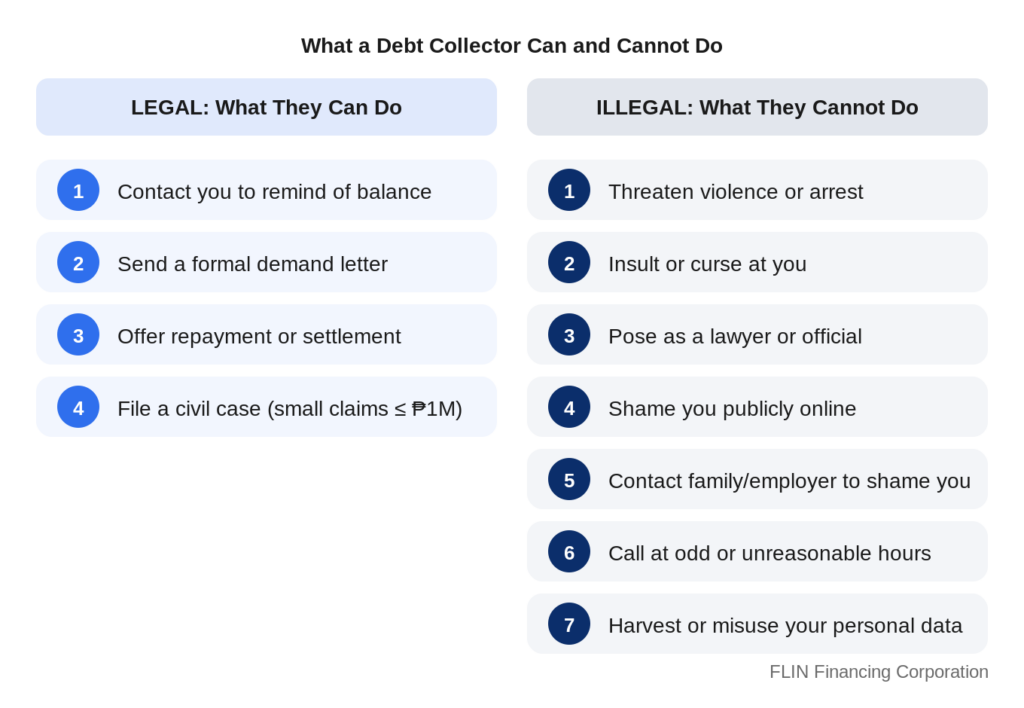
- Phone calls to you. Collectors are allowed to call and message you about a genuine debt to remind you of your balance and follow up on payment.
- Contacting your family. They may reach out to a family member only in limited, legitimate cases, such as a co-maker or guarantor who is actually part of the loan.
- Calling your employer. A collector may contact your workplace only to verify your employment.
- Home visits. A collector may visit your home to follow up on a debt, as long as the visit stays lawful and respectful.
- Filing a civil case. If you refuse to pay, a collector may take you to court to recover the debt, usually through the small claims process for amounts up to one million pesos.
What Debt Collectors Cannot Do to Reach You
- Harassing phone calls. They cannot bombard you with calls at all hours or use threats and insults. Contact at unreasonable times, such as very early morning or late at night, is not allowed.
- Shaming your family or contacts. They cannot contact your relatives, friends, or phone contacts just to embarrass or pressure you. Doing so may violate SEC rules and the Data Privacy Act.
- Pressuring your employer. They cannot repeatedly call your office, disclose your debt to your colleagues, or use your job as leverage to shame you into paying.
- Texting your phone contacts. Many lending apps request access to your contact list on installation, but using that list to message or shame the people you know is a clear violation of SEC rules and the Data Privacy Act.
- Threatening or trespassing during visits. During a home visit, they cannot threaten you, harass you, intimidate you, or enter your property without permission.
- Threatening arrest. You cannot be jailed for an unpaid loan. Article III, Section 20 of the Constitution states that no person shall be imprisoned for debt, so this is always a civil matter, never a criminal one.
- Posing as an official. They cannot pretend to be a lawyer, court officer, or government agent to frighten you into paying.
Many online lending apps request access to your entire contact list on installation, then use it as a weapon. That contact-list harvesting and debt-shaming is one of the most reported violations in the country, and it’s not something you have to tolerate.
Your Rights as a Borrower
You hold more power than a collector’s tone suggests.
- First, you cannot be imprisoned for debt. The Constitution guarantees it. A private loan is a civil obligation, and any collector threatening you with jail for non-payment is bluffing.
- Second, you have the right to be treated with respect and fairness. The financial consumer protection framework requires it, and abusive tactics are punishable.
- Third, you have the right to privacy. Your unpaid balance does not give anyone the right to broadcast your situation to your contacts or online.
- Fourth, you have the right to complain and be heard through official channels, with real consequences for lenders who break the rules.
One crucial point: harassment does not cancel your debt. If the loan is valid, you still owe it. But harassment is a separate wrong that you can act on independently. Treat them as two different problems.
How to Deal With a Debt Collector
Staying calm and organized beats panicking every time.
- Verify who you are dealing with. Ask for the collector’s full name, the company they represent, and their written authority to collect. Legitimate collectors will provide it. If someone claims to be a lawyer, ask for their name and IBP number.
- Ask for the debt in writing. A formal demand letter stating the exact amount and breakdown protects you from inflated or fabricated figures.
- Document everything. Log every call with dates and times, save every text and chat message, and screenshot any social media posts. This record is your strongest evidence if you need to file a complaint.
- Communicate, don’t hide. Ignoring a legitimate debt only makes it worse and can lead to a valid court case. If you genuinely owe the money, engaging on a realistic repayment plan is far better than silence.
- Protect your data. If an app has harvested your contacts, preserve the evidence first, then revoke unnecessary permissions and consider uninstalling. Do not ignore any genuine court notice, though.
Where to Report Harassment
Match the complaint to the right agency:
- For abusive collection by a lending or financing company, file with the SEC.
- For contact-list harvesting or debt-shaming that misuses your personal data, file with the National Privacy Commission.
- For harassment by a bank or a bank-supervised entity, raise it with the bank first, then escalate to the BSP Consumer Assistance Mechanism
- For threats, fake posts, hacking, or cyber libel, go to the PNP Anti-Cybercrime Group or the NBI Cybercrime Division.
Regulators take this seriously. The SEC receives thousands of complaints each year, most of them about unfair collection and harassment, and it actively flags and warns the public against illegal, unregistered lending apps.
This is where FLIN comes in. FLIN is a debt resolution facilitator, not a lender. The goal is not to add another loan to your pile, but to assess your full situation, identify realistic options such as restructuring, debt consolidation, or negotiation, and help you move toward a single, manageable path forward. If collectors are calling from every direction, a calm, no-pressure consultation can help you take back control. The debt may be real, but so are your rights, and you deserve to be treated fairly while you resolve it.
Find out more ways to solve your debt via the following articles: